


Nature, Art, and Music for Sensory Support in Autistic Children.
- ascendbehaviorconsultants

- 3 days ago
- 10 min read
The first years after an autism diagnosis can feel like learning a new language. A child may cover their ears at the blender, melt down in a crowded store, seek deep pressure by crashing into cushions, or become calm when watching leaves move in the wind. These reactions are not “bad behavior.” They are clues about how the nervous system is taking in the world.
For children under 5, sensory support works best when it is gentle, predictable, and woven into daily life. Nature, art, and music can help because they offer rich sensory input without needing fancy equipment. In the Southeast, families also have year-round access to porches, backyards, parks, pine woods, shaded trails, beaches, creeks, gardens, and rainy-day indoor nature play.
This guide is informational and not a substitute for medical care, occupational therapy, speech therapy, or advice from a child’s care team. It can help first-time parents build simple, safe routines that support regulation, connection, and play.

Sensory differences are part of how many autistic children experience the world
Autism can affect communication, social interaction, play, routines, and sensory processing. Some young autistic children are very sensitive to sound, touch, light, smell, taste, or movement. Others seek more input, such as spinning, jumping, squeezing, chewing, or making repeated sounds. Many children have a mix of both.
A child may be:
Sound sensitive Startled by hand dryers, vacuum cleaners, church music, fireworks, thunderstorms, or crowded family gatherings.
Touch sensitive Upset by sticky hands, grass, sand, hair washing, seams in clothing, or finger paint.
Movement seeking Drawn to rocking chairs, swings, running, climbing, bouncing, or spinning.
Visually overwhelmed Distressed by bright stores, flashing toys, busy wallpaper, or strong sunlight.
Comforted by repetition Focused on the same song, the same path through the yard, the same leaf pile, or the same art motion.
Sensory support starts with observation. Before adding activities, watch what helps the child settle and what seems to build stress. A simple note on a phone can help.
For example:
What happened | What it may suggest |
Covered ears when the blender ran | Sound sensitivity |
Rubbed hands through dry rice for several minutes | Enjoys tactile input |
Calmed after swinging on the porch | Movement helps regulation |
Cried when paint touched fingers | Wet textures may feel uncomfortable |
Hummed during transitions | Sound may help with predictability |
These patterns can help guide activities. The goal is not to force a child to “get used to” uncomfortable sensations. The goal is to offer safe, respectful ways to explore the senses while protecting the child’s sense of control.
Nature gives sensory input that changes at a child’s pace
Nature is full of sensory experiences, but it is often easier to adjust than a busy indoor setting. A pinecone can be touched or ignored. A creek can be watched from a distance. A child can sit in the shade instead of joining a noisy playground.
In the Southeast, climate shapes the plan. Heat, humidity, mosquitoes, pollen, sudden storms, and strong sun matter. Early morning and late afternoon are often better than midday. Shaded areas, water bottles, hats, sunscreen, and insect protection can make outdoor play more comfortable.
Start with a small outdoor “safe zone”
A safe zone can be a corner of the yard, a porch mat, a picnic blanket under a tree, or the same bench at a local park. Keep it simple and familiar.
Try adding:
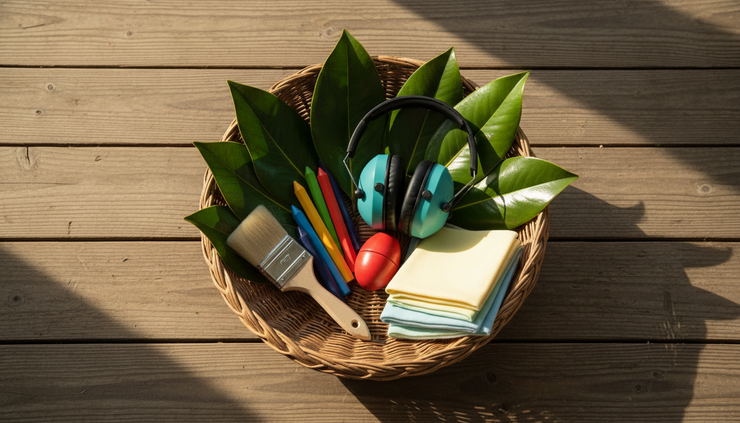
A small basket of leaves, pinecones, smooth stones, or seed pods
A towel or blanket for children who dislike grass
A water cup and paintbrush for “painting” the porch or fence with water
A bubble wand
A wagon, stroller, or carrier for breaks
Noise-reducing headphones if sound is a known trigger
The same place, visited often, can become a calming routine. A child may start by watching. Later, they may touch one leaf. Later still, they may sort rocks, stomp in puddles, or listen for birds.
Use nature walks as sensory check-ins
A nature walk with a toddler or preschooler does not need to look like exercise. It may be 10 minutes in the driveway or a slow loop around the same tree.
Try a “one sense at a time” walk:
Look for one color, such as green, brown, or yellow
Listen for one sound, such as birds, wind, or water
Touch one safe texture, such as bark, a leaf, or a smooth rock
Smell one mild scent, such as rosemary, mint, or rain on warm pavement
Keep choices limited. “Do you want leaf or rock?” works better than “What do you want to do outside?” for many young children.
Respect weather as part of sensory life
The Southeast has big sensory seasons. Spring pollen may make outdoor time harder. Summer heat can increase irritability. Fall leaves may be wonderful for crunching and sorting. Winter can still offer outdoor play in many areas, especially on mild days.
If a child struggles in heat, try:
Water play in a shaded bin
Early morning walks
Barefoot play only if the child enjoys it and the ground is safe
A damp washcloth for cooling hands or neck
Indoor nature trays during high heat or storms
Nature support should feel like relief, not another demand.

Art gives children a way to explore texture, color, and control
Art can be a powerful sensory tool because it lets a child change the world in a visible way. A mark appears. A color spreads. A sticker sticks. Clay squishes. Paper tears.
For autistic children under 5, the process matters more than the finished picture. A child may only make dots, smear one color, line up crayons, or watch someone else paint. That still counts.
Offer low-pressure art choices
Many first-time parents feel tempted to set up cute crafts with a clear end product. A handprint turkey or perfect rainbow may be too much for a child who dislikes messy touch or multi-step directions.
Use open-ended materials instead:
Large crayons or washable markers
Dot markers
Water and a paintbrush
Dry paintbrushes on cardboard
Stickers on paper
Torn paper collage
Play dough or therapy putty, if safe and age appropriate
Finger paint in a sealed plastic bag for no-mess squishing
Nature stamps using leaves or okra slices
A child who avoids wet textures can still enjoy art. Tape paper to the table and offer a sponge brush. Put paint in a zip-top bag and let the child press from the outside. Use chalk outdoors so cleanup is easy.
A child who seeks strong input may enjoy:
Tearing paper
Rolling dough with both hands
Pressing cookie cutters into clay
Stomping on bubble wrap with supervision
Painting with a large brush on cardboard outside
Build control into every art activity
Control helps reduce sensory stress. Let the child choose between two colors, two tools, or two surfaces. Keep wipes nearby, but avoid wiping hands too often if the child is exploring comfortably. Some children experience constant wiping as more upsetting than the mess.
Helpful phrases include:
“All done paint.”
“Wipe hands or keep going?”
“Brush or sponge?”
“Your body says stop.”
“We can try again later.”
These words teach body awareness and self-advocacy. They also show the child that communication works, even before speech is clear or consistent.
Bring the Southeast into art without making it complicated
Local textures can add meaning and variety. Use what is safe, clean, and not a choking risk.
Try:
Leaf rubbings with magnolia, oak, or maple leaves
Pine needle painting with a bundle tied loosely at the end
Sand art in a tray after a beach trip
Pressed flowers from a garden
Mud painting outside after rain
Shell sorting for children who no longer mouth small objects
Always supervise closely. Many children under 5 still mouth objects, and some autistic children may do so longer. Skip small items if they are not safe for the child’s current stage.
Music helps with rhythm, transitions, and regulation
Music can organize time. That is one reason songs work so well for young children. A clean-up song says what is happening now. A goodbye song marks an ending. A slow rocking song can help the body settle.
Music also gives sensory input through sound, rhythm, vibration, and movement. For some autistic children, music is calming. For others, it can become overwhelming fast. Volume, tempo, repetition, and predictability all matter.
Use songs as transition supports
Transitions can be hard because they ask a child to stop one sensory state and enter another. A song can make the change less sudden.
Use the same short song for the same routine:
Washing hands
Getting in the car seat
Putting on shoes
Cleaning up toys
Starting bath time
Getting ready for bed
The song does not need to be polished. A simple repeated phrase works:
“Shoes go on, shoes go on, then we go outside.”
Use the same melody each time. Pause before the last word to invite participation. A child may fill in the word, gesture, look toward the shoes, or simply relax because the routine is familiar.
Match music to the sensory need
Fast music may help a sleepy child wake up or move. Slow music may help after a busy outing. Steady rhythm can help with body awareness.
Try pairing music with movement:
If the child seems to need | Try |
Calming input | Slow rocking in a chair with a soft song |
Heavy work | Marching while carrying a stuffed animal |
Body awareness | Clapping knees, shoulders, then hands |
Predictability | The same two-song playlist before nap |
Sound control | A quiet instrument like an egg shaker or soft drum |
Some Southeastern families have strong musical traditions, from gospel and bluegrass to country, blues, marching bands, and church choirs. Family music can be a source of connection, but watch the child’s body. A crowded service, parade, festival, or family reunion may be too loud even if the music is loved at home.
Noise-reducing headphones, breaks outside, sitting near an exit, or listening from a distance can help.

Blend nature, art, and music into simple sensory routines
The strongest support often comes from combining activities in a predictable way. A routine does not need to be long. For a child under 5, five to 15 minutes may be plenty.
Try a calming porch routine
This works well before dinner, after preschool, or after a loud errand.
Sit in the same outdoor spot.
Sing the same short hello song.
Offer two nature items, such as leaf or pinecone.
Let the child touch, sort, look, or ignore.
Paint with water on wood, concrete, or cardboard.
End with the same goodbye song.
This routine includes sound, touch, vision, movement, and predictability. It also gives the child choices.
Try a rainy-day sensory tray
Southern storms can be intense, and thunder may scare sound-sensitive children. An indoor tray can bring nature inside without the heat or noise.
Use a shallow bin with:
Large leaves
A few smooth stones, if safe
A paintbrush
A small cup of water
A towel
A quiet song or steady hum
Let the child brush water on leaves or stones. If thunder is upsetting, pair the activity with headphones, a cozy corner, or deep pressure if the child enjoys it.
Try a beach or creek wind-down
For families near the coast, lakes, rivers, or creeks, water can be regulating for some children and overwhelming for others. Safety comes first. Stay within arm’s reach around water.
A gentle routine could include:
Watching water from the same spot
Scooping sand with a large cup
Humming a slow song
Drawing lines in damp sand with a stick
Rinsing hands in a predictable way
Leaving before the child is exhausted
End while things are still going well when possible. A short successful visit builds confidence better than a long visit that ends in distress.
Watch the child’s cues and adjust quickly
Sensory activities should support the child’s nervous system. They should not become tests of tolerance.
Signs an activity may be too much include:
Turning away
Covering ears or eyes
Crying or screaming
Dropping to the ground
Running away
Freezing or becoming unusually still
Increased biting, hitting, or throwing
Repeating “no,” “stop,” or an all-done sign
Signs an activity may be helping include:
Softer face or body
More steady breathing
Longer attention
Gentle repetition
Shared smiles or eye contact, if comfortable for the child
Seeking the activity again
Easier transition afterward
When distress shows up, reduce input. Make the space quieter. Move to shade. Put away the paint. Stop singing. Offer pressure, space, water, or a familiar object based on what usually helps.
A useful rule is less, slower, softer. Fewer materials. Slower pace. Softer sound. This can turn an overwhelming activity back into a supportive one.
Work with therapists and caregivers without losing the home connection
Occupational therapists often help families understand sensory preferences and build sensory diets or regulation plans. Speech therapists may use songs, gestures, and play routines to support communication. Early intervention providers can help adapt activities for developmental needs.
Parents can bring helpful details to appointments:
“He calms when he rocks on the porch.”
“She hates finger paint but likes dry chalk.”
“He covers his ears during church music.”
“She loves water play but melts down during hair washing.”
“He hums before transitions.”
These observations are valuable. They help professionals tailor support to the child, not just the diagnosis.
The same applies to grandparents, daycare teachers, Sunday school volunteers, and babysitters. Share one or two simple routines that work. Keep instructions short.
For example:
“After lunch, she likes five minutes on the porch with chalk. Please keep it quiet and let her stop when she signs all done.”
That kind of guidance can prevent sensory overload and help the child feel understood across settings.
A gentle starting plan for the first week
A first plan should be small enough to repeat. Pick one nature activity, one art activity, and one music cue. Use them at the same time of day for several days.
Here is a simple example:
Day | Sensory support |
Monday | Sit outside for five minutes and touch or look at leaves |
Tuesday | Paint with water on the porch or sidewalk |
Wednesday | Sing the same shoe song before going outside |
Thursday | Combine the leaf basket, water painting, and song |
Friday | Repeat the activity that seemed most calming |
Weekend | Try the routine with another trusted caregiver nearby |
Keep expectations low. The child does not need to complete the activity. Watching counts. Refusing gives information. Repeating one motion may be the point.
The best early supports are the ones a family can actually do on a hard day.
The takeaway for first-time parents
Nature, art, and music can make autism sensory support feel less clinical and more connected to family life. A shaded porch, a basket of leaves, a soft song, and a paintbrush dipped in water can become tools for regulation, communication, and trust.
Start small. Follow the child’s cues. Protect comfort and safety. Repeat what works. In the Southeast, the natural world offers many gentle entry points, from pinecones and rain puddles to beach sand and evening birdsong.
A young child does not need a perfect sensory routine. They need caring adults who notice what their body is saying and respond with patience. That is where support begins.

Comments